

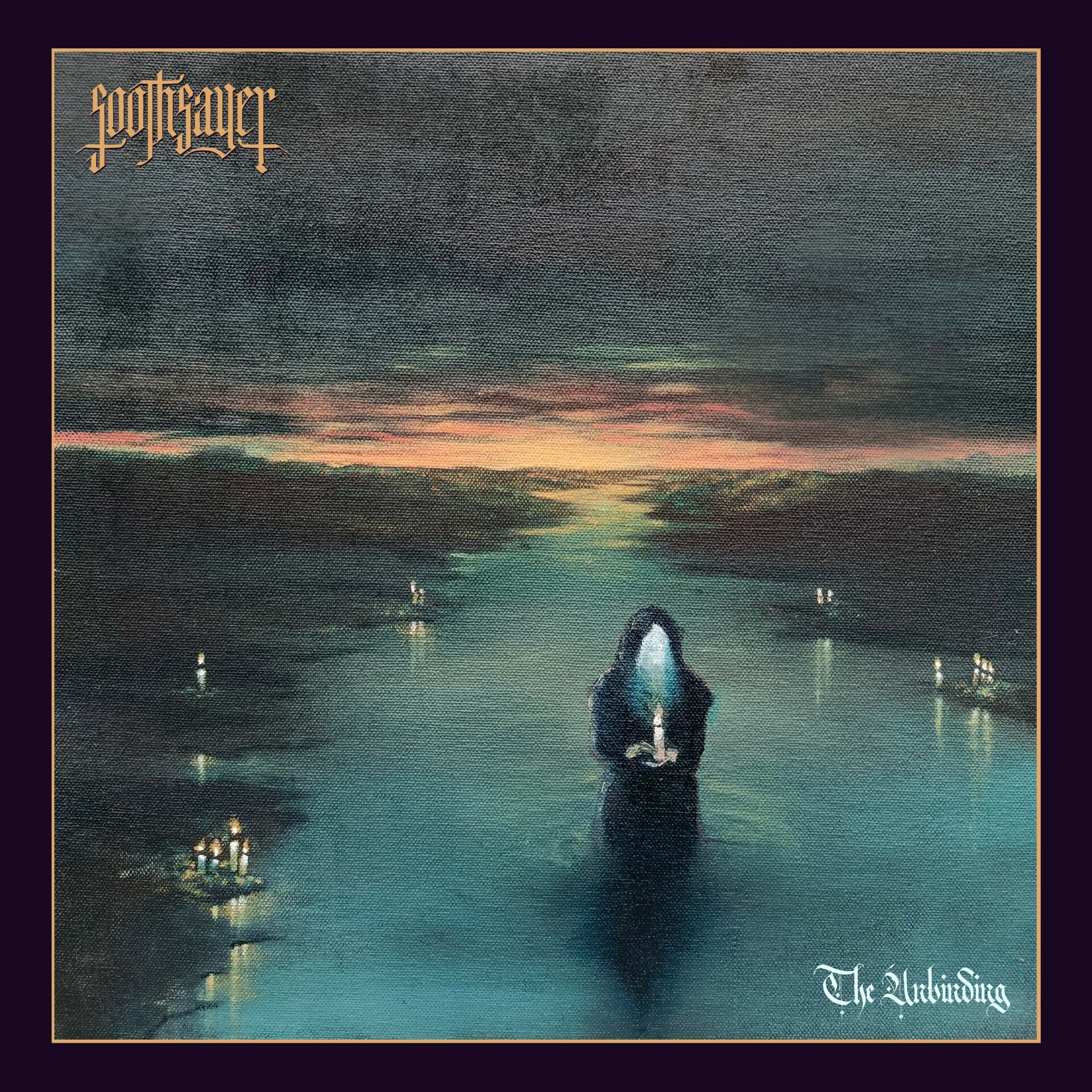

Release Date July 3rd, 2026
Format Vinyl/CD/Cassette/Digital
Genre Atmospheric Blackened Doom Metal
Origin Ireland
Soothsayer formed in County Cork in 2013 and has followed an unusually restrained path through atmospheric blackened doom metal. Their catalogue remains small, with several shorter releases and one previous full length, “Echoes Of The Earth”, issued in 2021. That limited output has given each appearance a distinct place in the group’s development, and “The Unbinding” arrives as the work of musicians who have spent years refining a bleak mixture of doom, black metal, folk colour and spiritual unease. The current line up consists of Liam Hughes on vocals, Marc O’Grady and Con Doyle on guitars, Gerard O’Callaghan on drums and Pavol Rosa on bass.
Their music is tied closely to Irish landscape, inherited memory, grief and old cultural shadows, though it rarely settles into obvious Celtic metal patterns. Soothsayer uses those roots as atmosphere, not decoration. Across their history, the band has preferred long compositions, severe emotional contrasts and a vocal approach that moves between lament, invocation and near feral expression. Signing with Apocalyptic Witchcraft places this second album beside a label catalogue suited to extreme music with an occult and mournful character, while leaving Soothsayer’s own character intact.

“The Unbinding” begins with immediate violence, and then sinks into funeral paced passages where guitars stretch into grey horizons and the drums strike with ceremonial gravity. Contrast defines the album. Rapid black metal eruptions collapse into towering doom, acoustic phrases appear inside scorched electric sections, and melodies surface briefly before being swallowed again. “Eroding The Sky” offers an early example, using an initial assault as an entrance into a much darker and more expansive section. “Sooner Acceptance” shifts between fragile guitar work, anguished singing and broad doom chords, refusing a comfortable centre.
Elsewhere, “The Vine” brings the emotional temperature close to breaking point, while “A Vague Shimmer” closes the album with Celtic guitar lines, mournful percussion and a final descent into loss. These references do not turn the album into a sequence of isolated moments. The songs belong to one continuous descent, built around grief, rage, heritage and spiritual separation. Shaun Cadogan handled the engineering in Dublin, and the production gives the album scale without flattening its rougher edges. The guitars have depth, the bass remains present beneath the larger chords, and the drums sound physical without becoming oversized.
Hughes dominates large sections, sometimes to the point where his delivery nearly overwhelms the surrounding music. His range is broad, moving through plaintive singing, deep roars, rasped declarations and haunted spoken phrases. At its best, that performance gives “The Unbinding” a human centre. At other points, the constant intensity can blur the difference between anguish and excess. The same issue appears in several extended passages. Soothsayer builds carefully, though some crescendos run longer than their ideas require, and the middle section can merge into one prolonged state of sorrow. This is where the album falls below the exceptional tier. The atmosphere is rich, the musicianship is disciplined and the emotional content is sincere, though greater editing could have made certain sections more decisive.
The Celtic elements matter because they deepen the album’s cultural background, especially near the closing section, where guitar motifs and percussion suggest older forms without turning into costume. “The Unbinding” is a substantial second album, severe in tone and rich in detail, with enough variation to reward repeated plays. Its longer stretches occasionally lose definition, and the vocal extremity can become overbearing, though the overall result remains engrossing, bleak and emotionally credible. Soothsayer has made an album with real depth, a firm connection to place and a dark atmosphere that lingers after the final note.
|7.8
Add comment
Comments