

Three years after “Bloodmoon,” you’re back with “Wayfarer”. How would you describe the evolution of the band between these two albums?
Bruno: I think, Kerrigan has matured to a point where we are very confident about the style of heavy metal we want to create. With the final lineup of four band members, we have taken a big step and they have helped us shape the songs that Jonas and I wrote. With the many shows we played, we have also found out more about our strengths as a band.
Jonas: The band took many steps evolving from a two-piece with a session drummer to a real band performing live. Hitting the stages added a lot to the experience because we got to talk to so many supporters, made friends along the way and gained a real identity as a band.
You have mentioned that “Wayfarer” continues directly where “Bloodmoon” left off. Was that a conscious decision from the start, or did it happen naturally during songwriting?
Bruno: When we finished “Bloodmoon”, we had many leftover riffs and even full songs that didn’t make the cut back then. So naturally, when we started to write for a new album, we took these older bits and pieces into considerations and some of them turned into full songs (like “Blood And Steel” or “Wayfarer”). So there is a bit of “Bloodmoon” in “Wayfarer”. Even with the recordings of this new album, we already had new song and riff ideas that are sure to make it on the next record.
Jonas: It happened naturally like most things about Kerrigan. We never really stopped writing songs, so we got to the point of finishing the ones we wanted for the new album quite early.
Some songs like “Blood And Steel” date back to the “Bloodmoon” era. How did those older ideas transform into the final versions we hear now?
Jonas: “Blood And Steel” went through different stages when it comes to pacing, but the chorus was the first thing we came up with during the recordings for “Bloodmoon” and it never changed.
Bruno: I remember very vividly how excited we became during a studio break in the recording sessions for “Bloodmoon”. I guess Jonas came up with the main riff and we immediately added some make-up lyrics to it, and the chorus actually stuck until the very end. This is what became “Blood And Steel” in the end. There is a fun cellphone recording of this improvisation. All we had to do was add some of the Kerrigan magic and make a full song out of it. I think it’s one of the strongest yet.
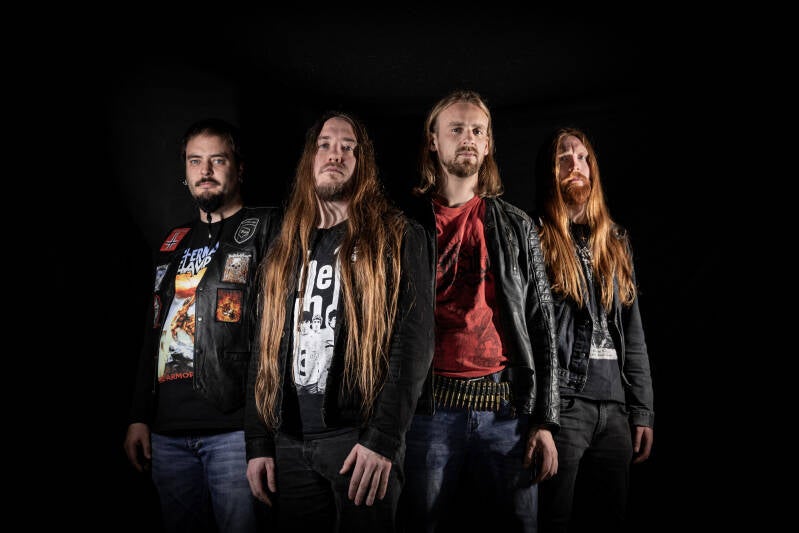
“Wayfarer” is described as “dreamy, melancholic, and pretty versatile.” How did you balance those moody, atmospheric elements with the high-energy demands of traditional heavy metal?
Jonas: When we were done with the recordings and started the production of “Wayfarer” at Iguana Studios we knew that we needed a little softer, less gain sound compared to “Bloodmoon”. I think the way we approached that added the right balance between the moody character and the natural punch heavy metal needs.
Bruno: There’s something quite harsh about the sound of “Bloodmoon” that we wanted to address. So naturally, the guitar sound and overall mixing turned out a bit different. I think the mood is something special to Kerrigan: even on "Bloodmoon" I think some of the track sound a bit more dreamy and melancholic than other NWOTHM bands usually do. I think it’s fantastic that we are a bit unique in that sense. You can still always pack in a fiery solo or shredding riff, which I think we did.
You have noted that this album represents everything you love about '80s metal bands, specifically songs that are accessible but packed with interesting details. Which bands or albums from that era served as the biggest blueprints for you while crafting “Wayfarer?”
Jonas: I couldn’t name an album because that’s not how we approach our writing. As soon as we notice that we’re just copying classics we have to take a step back and change the course. Of course we have our influences and when it comes to heavy metal you’ll recognize Priest or Maiden but Kerrigan is mostly influenced by good songwriting in general just like you had it in the 80s regardless of the genre. Just to name a few bands that added something to our style: Wolf (UK), Quartz, Heavy Load, The Smiths, Ultravox, and many more.
Bruno: Like Jonas said, we are more influenced by some of the quirky and forgotten heavy metal acts of the time. Myself, I’d add Witchfinder General to the list. But as pointed out already, a lot of personal influence for me comes from 80s post-punk. We even dedicated a tribute song to the glorious Smiths on our 7” version of “The Ice Witch”.
You said you aimed for something like a “modern heavy metal classic.” That’s a bold goal, not exactly a small target. What does a modern classic mean to you in 2026? You’ve raised the bar a lot. Are you ready to accept any challenge?
Bruno: This quote keeps circling around and it’s a statement I made in a more laughing manner. But what I meant by that is that we wanted to make a record that really sticks with people. There are many great albums but also a lot of mundane ones that sound good at first listen but don’t really have the songwriting to make it stick. So our focus was to write an album with no filler material and songwriting that will make people want to re-listen many times. Just like with the aforementioned ‘classics’ that really stood the test of time. Did we succeed with “Wayfarer”? To be honest, I don’t know. It’s up for the fans to decide. I think it’s good to be ambitioned in that sense, but we would never claim that we achieved a ‘classic’ status. It’s just a goal we set for ourselves: don’t be boring, be consistent, put out high quality material.
"Our focus was to write an album with no filler material and songwriting that will make people want to re-listen many times."
Tracks like “The Ice Witch” and “Fighter” sound like they belong to different emotional worlds. Is that range part of the identity, or are you still figuring out what Kerrigan really are?
Jonas: I think that we found our identity as a band and our own style. Just like in life there must be ups and downs in music and you can’t stick to just one mood on a whole album, it would get boring very fast. Both songs you named came to us naturally, so there was no doubt that they’d be a part of the album. There’s too many bands focusing on speed and heaviness only, I think that’s a waste of potential.
Bruno: This diversity really is a strong point of the band in my opinion. I don’t think we want to miss any of these aspects. I quickly become bored of albums that are nonstop speed metal riffs with no breathers. When bands show their versatility, while still holding some core consistency, I think they are the most exciting. And I think both “The Ice Witch” and “Fighter” pass as true Kerrigan songs.
It's fascinating that the demos for “Surrender” and the title track “Wayfarer” were developing parallel to your debut. Do you find that your creative tap is always running, or did you have to consciously set aside time to finalize these ideas for the new release?
Jonas: When we got to the point of finished demos for all the songs we had to make a time schedule for the production, which was very busy at times as we still played live sometimes. At that point you have to set your focus, so we didn’t come up with too many new ideas, but maybe you’ll hear one of the few on our next record!
Bruno: Maybe it’s good to mention we also put out another 72 minute album with the other band Lone Wanderer. So there’s a lot happening and it’s also been a bit exhausting. I think, as a collective, we are in a surprisingly creative phase and as long as the ideas keep coming, we are very eager to turn them into songs. With the release of two albums almost simultaneously, we have some catching up to do (playing live and promoting), but there are already new ideas for Kerrigan which feel like we just have to grab them and turn them into new, fun songs.
Your sound is rooted in the 80s, but you’re clearly not just copying the past. How do you keep that classic spirit while still sounding fresh?
Jonas: The music you make always depends on what you’re listening to. As we both listen to mostly 80s music you’ll always recognize those roots in a Kerrigan song. As I’ve already said we are very careful to not just reproduce what’s been written perfectly many decades ago. Maybe it’s that ambition and the fact that we’re recording in the 2020s that gives it a “fresh” sound.
Bruno: For me, this is not a rational formula. We try and see what sticks but a lot of it is just intuition. The songwriting partnership with Jonas is something quite unique, because we never seem to write something that the other person wouldn’t stand behind. So there’s a big chemistry and we just try to keep it going. But I think both Jonas and I are very critical about our own riffs and we don’t allow ourselves to take any shortcuts. If something is boring, repetitive or reminds us about a classic metal song that already exists, we throw it away or re-write it. To me, being unique and presenting something that still holds some freshness in the year 2026 is very challenging but it’s the goal we have set for ourselves.
You previously spent time at Iguana Studios mixing “Bloodmoon”. How did your past studio experiences influence how you approached recording, mixing, and producing “Wayfarer?”
Bruno: The process at Iguana Studios is very productive and we had learned a lot from the “Bloodmoon” sessions. We also knew exactly what we wanted to be different, but the actually process of working with Christoph Brandes from Iguana is so efficient, professional and open minded that we naturally went there again to mix and record. We spent a bit more time tweaking the mix and did an extra day of drum recordings, but apart from that, it was mostly the same. A majority of the recordings are done by Jonas and me during many many weekend sessions, since we don’t live in the city. So what you can hear on “Wayfarer” (and “Bloodmoon”) is something that has been recorded over many sessions. These sessions can be very exhausting but I think it’s what makes Kerrigan in the end. Of course, the new bassist Jakob makes a big difference, too! He brings the riffs to life and adds a whole new dynamic in the band. We also wanted to make sure the bass gets a good spotlight in the mix compared to “Bloodmoon”.
You originally formed Kerrigan as a duo in Freiburg back in 2019, and Jonathan Döring stepped in as a session drummer for your debut, “Bloodmoon”. Now that Jonathan and Jakob are officially full-time members, how has the band's dynamic and creative process shifted?
Bruno: So far, it has not changed the creative process in a major way. Except that Jonathan and Jakob finalize and add their creative thoughts on the songs that Jonas and I still write as a duo. However, the overall impact of having a full band makes a big difference. It’s a ton of fun touring as a group and since we are not just band members, but friends, this just feels right. Jakob and Jonathan also act as quality control for the stuff we write. They too have a similar taste and feeling for what Kerrigan should sound like. So it’s really productive and a great dynamic.
Final question, let’s put you on the spot a bit, if someone listens to Kerrigan for the first time through “Wayfarer”, what do you want them to walk away with?
Jonas: I want them to walk away with a whole set of new earworms and the need to sing them live at one of our gigs.
Bruno: Ideally, they would want to re-listen to discover more details and really dig into the songs. In the long run, I would love for someone to listen to our record and share it with friends, maybe even get inspired to also start a band or promote local heavy metal. Let’s keep this scene alive. Thanks for the interview!



Add comment
Comments