

The conceptual core of “Threnodies” revolves around the "human unraveling" that occurs when one reaches too far into the Mythos. How did the band settle on this specific theme of "understanding too much," and do you view the album more as a warning or a chronicle of the inevitable?
As an avid Lovecraft reader with a personal philosophy that is akin to existential nihilism, I wanted to combine supernatural stories from the Cthulhu Mythos with the more earthly bleakness of our inevitable demise. Reaching too far into the realms of forbidden knowledge is only the direct cause of madness or death. Said finality itself is inevitable, and each attempt to transcend, meaningless. In that sense, It is closer to a chronicle. A quiet observation of a process that unfolds regardless of intent or awareness. I like albums that tell stories, which is why the songs are constructed in the way they are. Not around a catchy hook or a single dramatic emotion, but around a hermetic relegation of individual, insignificant slices of entropy. Each song captures a fragment of that unraveling.
The tracklist reads like a ledger of lost souls, from Francis Cobb to Edward Hope. Are these characters inspired by specific literary figures within the Lovecraftian or Gothic traditions, or are they original archetypes created to represent different facets of human grief and curiosity?
They are "original" archetypes, some drawn from real-life observations, some based on literary tradition, all with a slightly different brand of fatal personal drama that correlates to aspects of the human condition. Here my love for not just supernatural, but also Gothic horror creeps in. A lot of the fear present in those stories had to do with a sense of claustrophobia stemming from the tethered nature of life. The inability to step outside of one's own circumstances, even when confronted with something far greater. Each character reflects a different way of dealing with that limitation. Some resist, some accept, … some simply erode over time.
The album features contributions from German Dmitriev on violins and Fabio Alessandrini on drums, with exotic instrumentation by Justin Bruce. How did these external talents help shape the "horror tone" of the record compared to your previous work?
The violins have a tremendous impact on the overall sound and help shape the horror atmosphere to a large extent. German Dmitriev is an absurdly talented musician who just understood the music immediately. There was very little need for direction, which made the integration feel very natural. The intermezzo that Justin delivered for us was actually meant to be an accompaniment to "The Mystery Of Mosef Mehul"; it was so good that we decided to use it as a song on its own. It added a different kind of tension, outside the more structured compositions. As for the drums, we had planned to work with our friend Ed Warby again, but something came up and we were forced to look for help elsewhere. Fabio did a solid job, and we have received several compliments on the drums. His playing is controlled, not overly expressive, which fits the overall restraint of the album.
"It is my experience that real grief sets in after the anger, when there is simply emptiness in the shape of what was lost."
You’ve described the music as a "lament sung from within the void rather than against it." Practically speaking, how did you translate that feeling of "slow submission" into your guitar tones and song structures for this release?
The music and the lyrics do not represent a raging against futility and emptiness. Rather, they acknowledge its reality, albeit with a sense of sadness or dread. There is no real attempt to break out of it. The songs do not contain a plethora of riffs, but rather a modest amount of themes that recur in variations. That repetition is intentional. It creates a sense of being caught in something that does not resolve. The music is surprisingly technical, with complex chords and some more progressive, subtle rhythm changes, but none of it is meant to draw attention to it. Everything is built together as a whole into one musical monolith. And yet it doesn't have the same type of heaviness as funeral doom. It is, as you so aptly put it, the sound of slow submission experienced wide awake. It's hard to describe, and people will either "get it," or they'll likely deem it a failed attempt at something else.
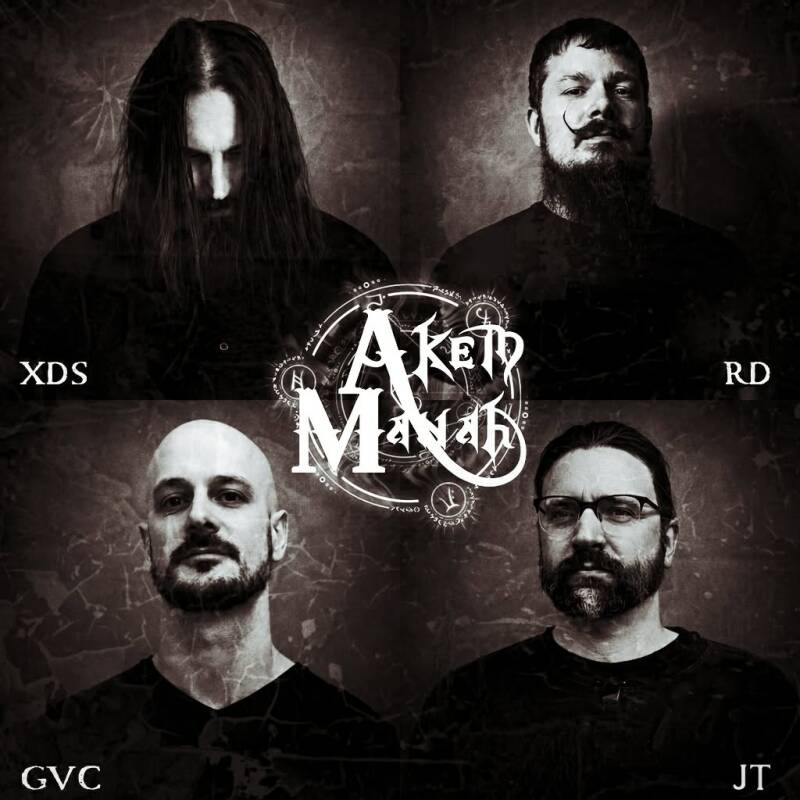
The credits show a diverse split in songwriting, with RD handling the majority of the tracks, while you and GVC also contributed key pieces. How do your individual writing styles differ, and how did you ensure the album felt like a cohesive "cycle" despite having multiple authors?
Since we are unable to rehearse, I live in Germany these days, we write the songs in GuitarPro. It is musical notation software that allows us to be precise and clear before recording. That already imposes a certain structure on how ideas are developed. Bassist and main composer RD runs those files by me, I suggest some small changes here and there, and then we finalize. His writing tends to be very deliberate, almost architectural. GVC usually delivers some melodies or riffs for us to incorporate, often with a slightly different emotional color. And I basically do my own thing and then run it past the others for approval, which tends to result in more overtly horror metal tracks such as “The Journey Of Nathaniel Johnson,” or, on the next album, some more cinematic, up-tempo pieces. Even with several authors, the end goal was clear from the beginning. The themes, the pacing, the general atmosphere were discussed early on. And I suppose the fact that I had a hand in everything did also help to create cohesion. Nothing was included that did not serve the overall direction.
Brett Caldas-Lima (Tower Studio) handled the editing, mixing, and mastering. Given his extensive resume, what specific "grit" or "atmosphere" did he bring to “Threnodies” that captured the "suffocating" nature of the riffs?
It was difficult finding the right studio. We were not looking for something overly clean or modern. At first, we had to get used to some of the effects and choices Brett made, but in the end we appreciate how it all falls into place. There is a certain density to the sound that supports the slower pacing of the songs. It sounds professional, but not too polished. Nothing stands out too much, which is exactly what we wanted. Every instrument, including the voice, is a part of the song and not an entity in itself. That lack of separation contributes to the suffocating feel.
“Threnodies” is being released via the Swedish label Black Lion Records. How has this partnership influenced the rollout of the album, and what drew a Belgian doom entity to a Swedish label known for its dark, atmospheric roster?
I am a fan of the label and their diverse roster of bands. They have the courage to go beyond niche programming, which is what a lot of smaller or medium-sized labels do these days. They do not try to force everything into a specific mold. So I reached out to Oliver, and he said yes. It was quite straightforward. Having Black Lion Records has been great, with their promotional tools and sales network reaching places we could not on our own. It gives the album a wider exposure without changing anything about how we approach the music.
The word threnody comes from the Greek thrēnoidia (thrēnos – wailing, and ōidē – song). In Ancient Greece, these were structured, communal laments for the dead. Why did you choose this specific term over more common metal descriptors like "Requiem" or "Dirge," and how did the Greek tradition of formal mourning influence the "ritualistic pacing" of the album?
I am a classicist and studied Ancient Greek and Latin in school. Even though that was a lifetime ago, it influences my use of language to this day. I will often, consciously and subconsciously, use words derived from either and even structure sentences in a similar manner. For this album, "Threnodies" felt more fitting than similar terms. It carries the weight of the theme without being overused.
In Greek tradition, mourning was not just an outburst of grief but something almost ritualistic, with a defined place in society and literature, often tied to the ineluctability imposed by fate. Death was not an interruption, but rather a continuation of a structure that was always there for everyone and everything. This idea, that even the Gods are bound to death, or at least to its presence, plays into the aforementioned sense of inexorability. Because whereas death itself was not always the end, it was still final in the sense that it fixed things in place. Whatever happened afterwards did not undo what had already been set in motion. That is the aspect I find more relevant. The idea that once something has unfolded, it cannot be reversed. There is very little sense of escape. And that same inescapability carries over into 20th-century horror, particularly in the work of H. P. Lovecraft, where knowledge does not liberate but diminishes. The individual moves toward understanding, but that understanding strips away meaning rather than adding to it.
The problem is not death itself, but the realization of scale and irrelevance. You do not transcend anything. You just become aware of where you stand, and that awareness does not change the outcome. It aligns quite closely with existentialist thought as well. Writers like Albert Camus or Jean-Paul Sartre describe a world where meaning is not inherent, and where awareness of that fact becomes a burden rather than a gift. So the pacing of the album reflects that. It is not chaotic, and it is not explosive. It moves almost indifferently to the individual moments within it. That, to me, felt much closer to the idea of a threnody than something like a requiem or a dirge.
You mention that these songs are for "what in us dies when we understand too much." This echoes the ancient concept of catharsis or even the tragic realization (anagnorisis) found in Greek drama. Do you see the transition from human curiosity to "abyssal chaos" as a form of spiritual execution, where the person who started the journey effectively ceases to exist?
You know your Greek tradition. For myself, I compare my chronic depression to anagnorisis without peripeteia (Greek for adventure). Essentially seeing beyond the veil because your eyes adapted, rather than because the fabric was torn or lifted. So for me, the true drama has always been the absence of true drama. With Sophocles, for example, you have these tragedies building up to reality-shattering moments of insight that then elevate the tragedy to another level entirely. In real life, tragedy is usually sitting by itself in a corner, shedding a tear while holding the remains of a potted plant it stole from a stranger's funeral. It is my experience that real grief sets in after the anger, when there is simply emptiness in the shape of what was lost. But grief is not oblivion, and that is indeed where I assume we are all headed from the moment we start our voyage through existence.
The fact we can think about it at all is a useless by-product of us having outlived the base usefulness of our biological advantages when it comes to intellect. We are, in that regard, machines that continue to simulate meaning long after it has ceased to serve a purpose. The mind keeps generating narratives, projections, small illusions of significance, even when confronted with its own irrelevance. So the transition you mention is less an execution and more a gradual dissolution. The person who started the journey does not collapse in a single moment. They are gradually overwritten by the essence of that awareness.
How do you intent to support the promotion of the album?
We are grateful for every review and interview, every mention and every like. Other than that… We would like to play a few select concerts, but we are having a very difficult time finding the right musicians. Everyone we know is already in several bands or lives too far away. And other than playing live, it's a bit of a crapshoot these days. I will probably do the whole Spotify playlist thing, even though I am not a fan of the platform. It feels somewhat disconnected from the music itself, but it is part of how things work now. My naïve hope is that we will somehow grow our audience as organically as possible, thus laying the foundation for broader recognition and acceptance for the next album, which we are already writing. An album, that is shaping up to be quite eclectic and broader in scope.

Add comment
Comments